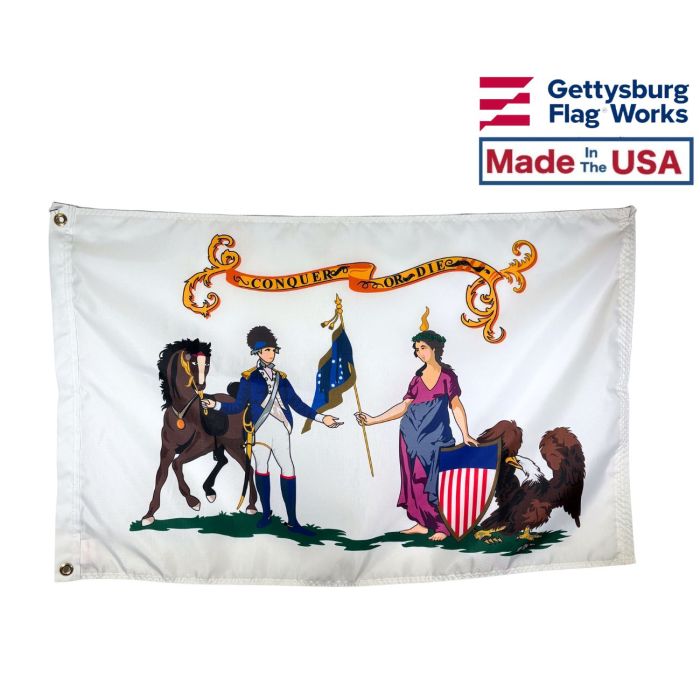
About the Washington Life Guard flag
Created in March 1776, the Washington Life Guard was tasked with guarding the Commander-in-Chief, his headquarters as well as his papers and effects. The flag itself shows a guard accepting their flag from the Genius of Liberty who holds up a union shield alongside an American eagle. The phrase “Conquer or Die” was the Guard’s motto, representing the most elite unit in the Continental Army. When Washington sent out the order to gather his guards, the qualifications included sobriety, honesty, good behavior, and being between 5’8” and 5’10” tall. Captain Caleb Gibbs, an adjutant of the 14th Massachusetts Continental Regiment, was given command of the unit. Gibbs was promoted to Major and given the title of Captain Commandant.
The official designation of this unit was “His Excellency’s Guard” or the “General’s Guard”. Other enlisted soldiers referred to them as “The Life Guards” or “Washington’s Body Guard”. In official correspondence, Gibbs signed “Commandant C-in-C, Guards”. The unit sported blue and buff uniforms with leather helmets adorned with medium blue cloth binding and a white plume tipped in blue and placed on the left side of the helmet. Gibbs insisted on having “USA” placed on the uniform buttons, rather than the typical designated regimental number. This is the first known record of that cipher being used. The Life Guards were disbanded in 1783 after the war. Their final order was to safely transport Washington’s personal effects, including eight years of war-time paperwork, to his home at Mount Vernon. Gibbs also gathered the official records of the Lifeguards and secured them at Charlestown Navy Yard. Despite surviving years of war, weather and constant movement, a majority of the records were destroyed in a fire at the Navy Yard in 1815.
Flag Size Recommendations
- 12x18” - Used on boats, wall decoration or on stick flags for celebrations
- 2x3’ - A smaller flag size usually used on large boats, RV’s or small flag poles
- 3x5’ - The most common flag size. Used on 6' house-mounted poles or in-ground poles up to 20' tall
- 4x6’ - Traditionally used on 25' tall in-ground flagpoles
- 5x8’ - Made for use on 30' tall in-ground flag poles
- 6x10’ - Made for use on 35' - 40' tall in-ground flagpoles
- Header and Grommet style - This is the most popular way to attach a flag and is used on house mounted poles and in-ground flag poles. Generally made of brass and connected via snap clip or plastic grommet rings like our rotating spinning pole.
- Need a bigger version of this flag? Contact us for assistance!
Related Products & Accessories
Expanding your historical flag collection with other historical flags, lapel pins and our whole collection of American Revolution flags has never been easier. Stocked and ready to go, you can get any of these powerful symbols of defiance and independence today.
Explore more of General Washington’s flags such as the Washington’s Cruisers flag his Personal Position flag and Washington’s Commander-in-Chief flag! Dive deeper into American history with our Founder's Collection, the perfect way to stock up on the symbols and stories that shaped America.