Fort Sumter Flag - 33 Star Civil War Flag
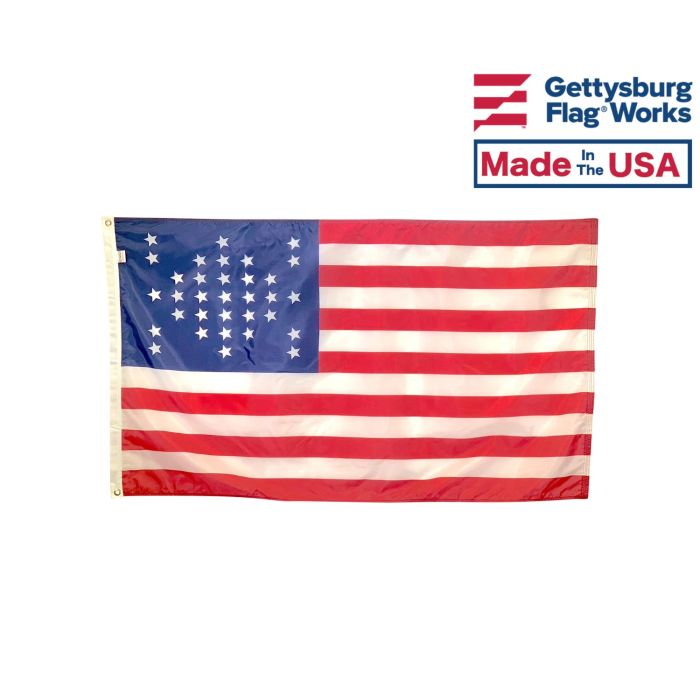
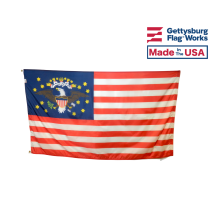
Thirty-three stars arranged in a bold diamond, with a single star anchoring each corner of the canton. It's one of the most recognizable star patterns in American flag history, and it belongs to the flag that flew over Charleston Harbor when the Civil War began.
This is a full-color reproduction of that flag, printed on all-weather nylon and finished for outdoor use. It's a favorite among Civil War reenactors, historical societies, museums, and anyone who wants to fly something with a real story behind it.
Why Thirty-Three Stars
The United States flag carried 33 stars from July 4, 1859 through July 3, 1861 — the period between Oregon's admission to the Union and Kansas's star taking its place on the flag. Kansas was actually admitted in January 1861, but by law a new star doesn't appear until the Fourth of July following statehood. That Fourth of July fell after the war had already started.
So the 33-star flag is the flag of the war's opening months and nothing else. It's a narrow, specific window, which is exactly what makes this design meaningful rather than generic. If you're representing the very beginning of the conflict, this is the correct flag. For later in the war, see the section below.
On the star pattern: Star arrangements weren't standardized until the twentieth century. Flag makers of the 1860s laid out their stars however they saw fit, which is why you'll find 33-star flags in ovals, circles, great-star patterns, and rows. The diamond seen here is the arrangement associated with Fort Sumter.
The Flag Over Charleston Harbor
On the night of December 26, 1860 — six days after South Carolina announced its secession — Major Robert Anderson quietly moved his command from Fort Moultrie across the harbor to the unfinished Fort Sumter, and raised the United States flag over it. For the next three and a half months that flag flew as the lone federal emblem in Charleston Harbor, with Confederate guns ringed around it.
At 4:30 in the morning on April 12, 1861, those guns opened fire. The bombardment ran thirty-four hours. Anderson's garrison was outnumbered, outgunned, and running out of everything. When the fort was surrendered, Anderson secured one condition above all others: his men would fire a salute to their flag before they marched out.
Then he lowered it, folded it, and took it with him. The fort was surrendered — the flag was not. Anderson carried it north, where it became one of the most powerful symbols of the Union cause in the entire war, flown at rallies and carried from city to city to raise money and rally recruits.
Four years later, on April 14, 1865, Anderson returned to the recaptured fort and raised that same flag over it again — to the day, four years after he had hauled it down. That night, in Washington, Abraham Lincoln was shot at Ford's Theatre.
Flags of the Later War Years
If you're representing a period after the summer of 1861, the 33-star flag isn't the right one — and we carry the flags that are. The star count shifted twice more during the war, and as with the Fort Sumter flag, the arrangements varied widely from maker to maker.
You'll find the full range in our War & Battle Flags collection, and other fortress and installation flags in our Fortress Flags selection.
How This Flag Is Made
Full-color digital print on durable all-weather nylon, with four rows of reinforced stitching at the fly end where wind damage starts. Canvas header and brass grommets, the standard attachment for outdoor flagpole use — clip the grommets to your halyard snaps and hoist.
The print is single-reverse, which is standard for historical and specialty flags. The design shows through to the back, so it reads correctly from one side and mirrored from the other. Sizes run from small display flags up through full flagpole sizes, and the 3x5' size suits most residential in-ground and house-mounted poles.
Every flag in this line is made in the USA. We've been making flags in East Greenbush, New York since 1993, and we take the made in the USA label seriously — it means the flag was manufactured here, not assembled here from imported goods.
Frequently Asked Questions
Why does this flag have 33 stars?
Because that was the official count when the Civil War began. The United States flag carried 33 stars from July 4, 1859 until July 3, 1861. Kansas became the 34th state in January 1861, but a new star doesn't join the flag until the Fourth of July following statehood — and by then the war was underway.
Was this flag captured by the Confederates?
No. Fort Sumter was surrendered, but Major Anderson lowered the flag and carried it north with his garrison. It went on to become one of the Union's most recognizable rallying symbols, and Anderson raised it over the fort again in April 1865.
Can I fly this outdoors year-round?
Yes. It's printed on all-weather nylon with reinforced fly-end stitching and finished with a canvas header and brass grommets — the same construction as our outdoor American flags. Like any flag, it will last considerably longer if you take it down during high winds and severe weather, and if you keep it clear of anything abrasive such as gutters, tree limbs, or rough siding.
Is this flag made in the USA?
Yes. This flag is manufactured in the United States, and we've been making flags here in East Greenbush, New York since 1993.
Questions About This Flag?
If you have a question about sizing, lead times on larger sizes, or which star count fits the period you're representing, contact us and we'll help you sort it out.