USS Alliance Flag
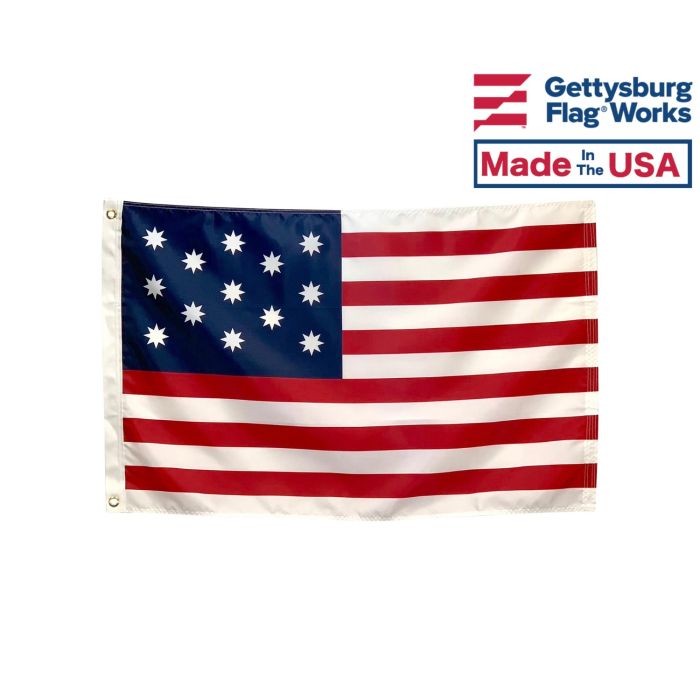
Most early American flags look like rough drafts of the one we know. The Alliance ensign looks like something else entirely. Thirteen stars, but each one has eight points instead of five. Thirteen stripes, but they run seven white and six red — which means the flag begins and ends with a white stripe, the reverse of every American flag made since. Set it next to a modern Stars and Stripes and the difference is immediate.
The design has carried the Alliance's name for well over a century, and it's what collectors, reenactors, and naval historians mean when they say "the Alliance flag." Its paper trail back to the ship is thinner than most vendors let on — more on that below, because we'd rather you have the real story than a tidy one.
Reading the Design
Three things set this flag apart from the more familiar thirteen-star designs, and they're worth understanding before you order.
The stars have eight points
The 1777 Flag Resolution called for thirteen stars on a blue field and said nothing at all about how many points a star should have. Flag makers filled in the blank themselves. Five-pointed stars won out eventually, but during the Revolution you'll find six-pointed and eight-pointed versions used with equal seriousness. This flag is among the best known of the eight-pointed designs.
The stripes start and end with white
Seven white stripes and six red, rather than the seven red and six white arrangement that became standard. This is the detail that surprises people most often when the flag comes out of the package. It is not a printing error and the flag is not upside down — the white-first arrangement shows up repeatedly in flags of the period, including the pattern associated with Francis Hopkinson, who designed the first official U.S. ensign. If you were picturing a red stripe along the top edge, better to know now than after it's on the pole.
The stars sit in rows, not a circle
Customers who have a ring of stars in mind are usually thinking of the Betsy Ross 13 star flag, which is a different design and the better choice if the circle is what you want.
The Ship Behind the Flag
The Alliance was laid down in 1777 on the Merrimack River at Amesbury, Massachusetts, by the cousins William and James K. Hackett. She launched on April 28, 1778 under the name Hancock, and was renamed Alliance by resolution of the Continental Congress a month later — a nod to the treaty with France that had just brought the war a powerful friend. At 36 guns she was widely regarded as the finest warship yet built in America.
Her early service was turbulent. Her first captain, Pierre Landais, was a former French naval officer who had come to America hoping to become the naval counterpart to Lafayette. His conduct at the September 1779 Battle of Flamborough Head, where the Alliance sailed as part of John Paul Jones's squadron, remains one of the more contested episodes in Continental Navy history. Command passed to Captain John Barry in 1780, and under Barry the ship found her stride, taking three enemy privateers and three Royal Navy warships between 1781 and 1783.
She also fired what are generally counted as the last shots of the Revolutionary War at sea, in a March 1783 action weeks after the fighting was supposed to have stopped. By 1785 she was the last ship left in the Continental Navy, and she was sold out of the service that August. The Navy that exists today traces its line back through her.
What the Record Actually Shows
In October 1779, after Flamborough Head, Continental ships put in at the Dutch island of Texel. The Netherlands was neutral, the British were furious, and the diplomatic situation was delicate enough that Dutch officials drew the ensigns flying over the American vessels and entered them in their register of naval flags. Two entries were made on consecutive days — one labeled Alliance on October 4, one labeled Serapis on October 5. That register survives, and it's the closest thing we have to a contemporary record of either flag.
Here's the complication. The sketch labeled Alliance is generally read as a Hopkinson-style flag — thirteen stars in staggered rows, with the seven-white-and-six-red stripe arrangement you see on this flag. The eight-pointed stars are the part that doesn't trace cleanly back to that entry. Where the eight-pointed version entered circulation isn't something we can document, and we're not going to guess at it in order to sound authoritative.
So what are you buying? The design that has been known as the Alliance flag for generations, and the one every reputable maker produces under that name. It is a genuine artifact of American flag history — just of the flag's later history as much as of the frigate herself. If you want a reproduction with an unbroken documentary line back to a specific ship on a specific day, this isn't it, and very few Revolutionary War flags are. If you want the flag that flies at naval commemorations and Revolutionary War events under the Alliance's name, this is exactly that.
Of Note: The Alliance and the Serapis
These two flags are cousins, and they get mixed up constantly. Both carry thirteen eight-pointed stars. Both are tied to the same October 1779 week at Texel. Both belong to the John Paul Jones chapter of the war. If you arrived here looking for "the early American flag with the unusual stars," it's worth a moment to make sure you've got the right one.
The difference is in the stripes.
USS Alliance
Red and white stripes only, running seven white and six red. Stars arranged in rows on a blue canton. Standard rectangular flag proportions.
Serapis
Red, white and blue stripes in an irregular sequence — the only early American ensign with blue in the stripe field. Stars arranged four, five, four.
If the blue stripes are what you remember, you want the Serapis flag. If you remember red and white only, you're in the right place. Both live in our Revolutionary War flags collection alongside the rest of the era's designs.
Construction and Materials
These flags are digitally printed on all-weather nylon, or nylon/Dacron depending on the size ordered, with reinforced stitching at the fly end where wind damage starts. The canvas header and brass grommets are the standard attachment for outdoor flagpole use — clip the grommets to your halyard snaps and hoist.
The printing is single-reverse, which is the standard method for historical and specialty flags. The design shows through to the back side, so the flag reads correctly from one side and mirrored from the other. On a flagpole this is rarely noticeable, since you see whichever side the wind gives you. For a wall or window display where the back will be visible, it's worth knowing in advance.
Every flag we make in this line is made in the USA.
Choosing a Size
Sizes run from 12x18" up to 6x10'. The small end of the range is meant for desk stands, boat staffs, display cases, and grave markers, not for a residential flagpole — a 12x18" flag on a 20' pole looks lost. The 3x5' size suits most residential in-ground and house-mounted poles. Larger sizes are typically ordered for commercial poles, museums, and historic sites.
If you're flying this alongside or beneath a U.S. flag, match the size of the flag above it rather than sizing to the pole. And if you're ordering 4x6' or larger, check the lead-time note on this page before you commit to a date.
Frequently Asked Questions
Why does this flag start and end with a white stripe?
Because that's how the design runs — seven white stripes and six red, the opposite of the modern arrangement. There was no fixed convention during the Revolution. The 1777 resolution specified thirteen alternating stripes without dictating which color went on top, and the white-first pattern appears in several flags of the period. Your flag is correct as shipped.
What's the difference between the Alliance flag and the Serapis flag?
The stripes. The Alliance flag uses red and white only. The Serapis flag adds blue, making it the one early American ensign with a three-color stripe field. Both use thirteen eight-pointed stars, which is why they're confused so often, but the star arrangement differs too — the Serapis groups them four, five, four.
Why do the stars have eight points?
The Flag Resolution of 1777 never specified a number of points. Flag makers of the period used five, six, and eight-pointed stars interchangeably, and several documented Revolutionary War flags use forms other than the five-pointed star we now take for granted.
Is this an accurate historical reproduction?
It accurately reproduces the design known as the Alliance flag — the version produced by every major maker under that name. Its connection to the frigate herself is less airtight than most listings suggest: the 1779 Texel register entry labeled Alliance is generally read as a Hopkinson-style flag, and the eight-pointed stars don't trace cleanly to it. We sell it because it's a real and long-established part of American flag history, not because we can prove the ship flew this exact design.
Can I fly this outdoors year-round?
Yes. It's printed on all-weather nylon with reinforced fly-end stitching and finished with a canvas header and brass grommets, the same construction as our outdoor American flags. Like any flag, it will last considerably longer if you take it down during high winds and severe weather, and if you keep it clear of anything abrasive — gutters, tree limbs, rough siding.
Questions About This Flag?
We've been making and selling flags out of East Greenbush, New York since 1993, and historical reproductions are some of our favorite work. If you have a question about the design, the sizing, the lead time on larger sizes, or whether this is the right flag for a display you're planning, contact us and we'll help you sort it out.