U.S. Navy Infantry Battalion Flag - Historical Navy Flag
The United States Navy went most of its history without a flag. The national ensign flew over its ships, its yards and its shore stations, and that was considered sufficient—a service flag, the kind an Army regiment carried into the field, had no obvious place at sea. But sailors went ashore, and men marching ashore need something to march behind.
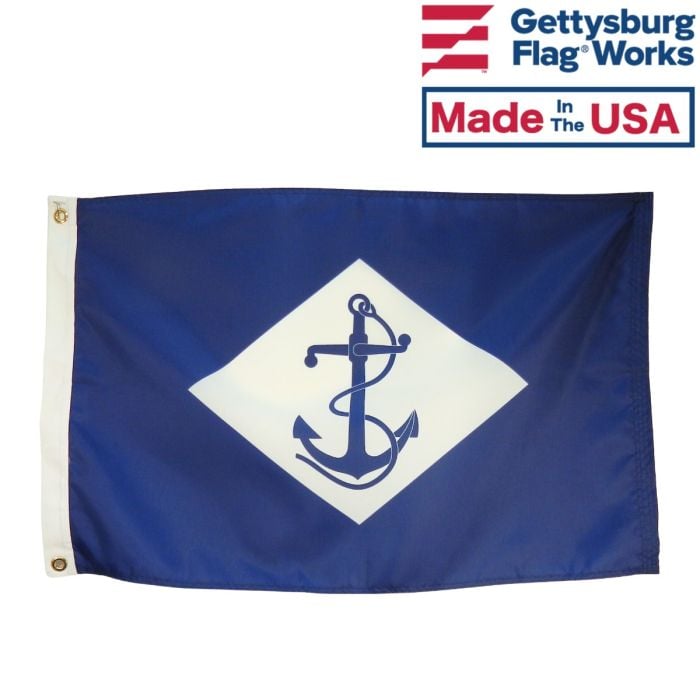
What they marched behind was this: a dark blue field, a white diamond at the center, and a dark blue fouled anchor laid across the diamond. It began as a flag for naval landing forces and ended up standing in for the entire Navy at parades, drills and ceremonies for more than sixty years, right up until 1959. It was never officially the Navy's flag. It simply did the job because nothing else did.
This Is Not the Current U.S. Navy Flag
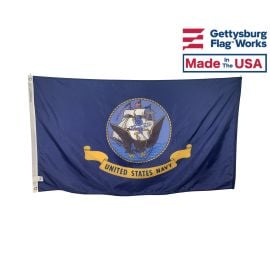
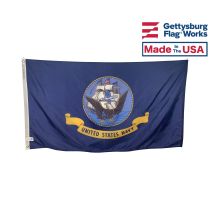
Worth settling before anything else, because it is the single most common mix-up on this page. The flag the Navy uses today is a dark blue flag bearing the seal of the Department of the Navy—an eagle with spread wings standing on an anchor, a three-masted ship behind it, and a yellow scroll reading "United States Navy" below. It looks nothing like this one.
If you came here looking for the modern Navy flag with the eagle and ship seal, you want our U.S. Navy Flag with Official Seal instead. This page is the flag that came before it.
You can also browse the full range at our U.S. Navy flags category, which covers outdoor flags, indoor sets, stick flags and more.
The Flag the Navy Used Before It Had One
The infantry battalion flag appears toward the end of the nineteenth century, introduced for the use of naval landing forces—the sailors who went over the side and ashore as an organized body, armed and formed into battalions. It shows up officially in Navy signal books in the closing years of the century, and from there its use widened well past its original purpose.
That widening is the interesting part. A flag issued for one narrow job drifted into becoming the flag people reached for whenever the Navy needed to be represented on land. Drill formations carried it. Parade details carried it. It stood in at ceremonies where every other service had something official to fly and the Navy did not. For better than sixty years it was the Navy's flag in every practical sense except the one that mattered on paper.
About the 1864 date
You will see it stated all over the internet, and in a good deal of flag catalog copy, that this flag was adopted in 1864. We would rather not repeat that, because the evidence behind it is thin.
The 1864 date traces back to a memorandum in the Navy Department Library that speculates the flag may have grown out of an order issued by Rear Admiral John Dahlgren in December 1864, distributing distinguishing pennants to the battalions of the fleet brigade—red for the howitzers, blue for the skirmishers, and white-blue for the Marines, marked with an anchor. That order describes pennants, not this flag, and the connection is a guess rather than a documented lineage. The arithmetic gives it away too: the standard account has this flag serving "more than sixty years" before 1959, which points to the 1890s, not the 1860s.
So the honest version is the one we have given above—late nineteenth century, landing forces, gradual promotion to something larger. We would rather tell you what the record supports than repeat a date because everyone else does.
Why the anchor is "fouled"
A fouled anchor is one with its cable wrapped around the shank and stock. In practical seamanship it is a nuisance—an anchor tangled in its own line is an anchor that will not set properly. As a heraldic device, though, it has been in naval use for centuries, going back to the Admiralty seal of the Lord High Admiral of England, and it crossed into American naval usage from there.
You will find plenty of explanations claiming the tangle symbolizes the trials and difficulties of a life at sea. That is a satisfying story and a popular one, but it reads more like folklore attached after the fact than a documented reason. The plainer answer is that the fouled anchor was already the established naval device when the U.S. Navy went looking for one, so the U.S. Navy used it. It still turns on the anchor worn by Navy chief petty officers today.
1959: The Navy Finally Gets a Flag
On April 24, 1959, President Eisenhower signed the executive order establishing an official flag for the United States Navy, and it was introduced to the public six days later at a ceremony in Maryland. The new flag was built around the seal of the Department of the Navy, specified at 4 feet 4 inches on the hoist by 5 feet 6 inches on the fly, dark blue, with a yellow fringe two and a half inches wide.
That order closed the chapter this flag belongs to. After more than sixty years of standing in, the diamond and anchor handed off to the eagle and ship—and became a piece of Navy history rather than a piece of Navy practice.
Printed or Sewn Applique: Which Should You Choose?
We offer this flag two ways. The choice comes down to how closely the flag will be looked at—and to nothing else. Both constructions use the same all-weather nylon, the same canvas header and brass grommets, the same reinforced stitching at the fly end, and both are single-reverse.
Digitally Printed
The design is printed into the nylon, saturating through the fabric. Ships faster, costs less, and at any real flying distance it is indistinguishable from the sewn version. This is what most customers flying a flag from a pole should be buying.
Sewn Applique
The diamond and the anchor are cut from separate pieces of nylon and stitched into place rather than printed. Up close you can see and feel the difference—defined edges, real dimension where the panels meet, the look of a flag that was built rather than run through a printer. It is our premium construction and it carries a longer lead time.
Where we will save you money: what sewn applique buys you is appearance up close, full stop. It is not more durable, it does not fly differently, and it does not read any differently on the back. If this flag is going up on a pole and being seen from the street, buy printed—you will not be giving anything up. Pay for sewn when the flag will be viewed close: indoors, on a wall, in a display case, or handed to someone.
Lead time on sewn
Sewn applique is made to order rather than pulled from stock, so it takes longer to get out the door than printed. If you are working toward a fixed date—a ceremony, a reunion, a retirement, a dedication—check with us before you order and we will tell you honestly whether the sewn version can make it. If it cannot, printed usually can.
What single-reverse means
Both constructions are single-reverse: the back of the flag is a mirror image of the front. On a flag with lettering that is a real consideration, and we say so plainly on those pages.
On this particular flag it is close to a non-issue. There is no lettering to read backwards, and both the field and the white diamond are symmetrical—so the only thing that changes on the reverse is the direction the anchor's cable curls. Most people never notice.
Choosing a Size
Use the size selector above to see what is currently available. If you are matching this flag to an existing flagpole rather than buying it for indoor or wall display, our flagpole size and ratio guide walks through the proportions that actually look right on a given pole height. Flying a flag that is undersized for the pole is the most common display mistake we see, and it is an easy one to avoid up front.
Larger sizes: 4x6' and up may require additional lead time on top of anything the construction adds. If you have a date you need to hit, get in touch before you order and we will confirm availability.
Need something outside the sizes listed, or a different material or finish? We manufacture custom flags, and this design is a straightforward one to produce to specification. Send us the details through our contact form and we will tell you what is possible.
Other Historical Navy Flags
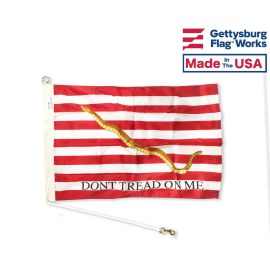
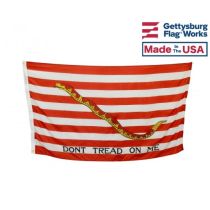
If this one caught your interest, the First Navy Jack—thirteen red and white stripes with a rattlesnake and "Don't Tread on Me"—is the other piece of Navy flag history people most often come looking for. It served as the Navy's jack from 2002 until 2019, when the Navy returned to the star field design.
Frequently Asked Questions
What flag did the U.S. Navy use before 1959?
This one. The infantry battalion flag—a dark blue field with a white diamond and a dark blue fouled anchor—served as the Navy's flag in all but name for more than sixty years, in drill formations, parades and ceremonies, until an official Navy flag was established by executive order in April 1959.
Is this the same as the current U.S. Navy flag?
No. The current Navy flag carries the seal of the Department of the Navy: an eagle standing on an anchor with a three-masted ship behind it and "United States Navy" on a scroll below. If that is the flag you want, see our U.S. Navy Flag with Official Seal.
What is the difference between printed and sewn applique?
Printed means the design is printed into the nylon. Sewn applique means the diamond and anchor are cut from separate pieces of nylon and stitched into place. Sewn is our premium construction and looks noticeably better up close. It is not more durable—both use the same nylon, header, grommets and reinforced stitching, and both are single-reverse. Sewn also takes longer to produce.
Which construction should I buy?
If the flag is going on an outdoor pole and will be seen from a distance, buy printed. You will not lose service life and the two are hard to tell apart at any real flying distance. Buy sewn if the flag will be viewed up close—indoors, on a wall, in a display case, or presented to someone.
Is the sewn version double-sided?
No. Both constructions are single-reverse, meaning the back is a mirror image of the front. Sewn applique changes how the flag looks up close, not how it reads from the reverse.
Was this flag really adopted in 1864?
Probably not. The 1864 date rests on a speculative link to an order issuing distinguishing pennants to fleet brigade battalions, not to this flag. The documentary record puts the flag's introduction toward the end of the nineteenth century, for use by naval landing forces.
Why is the anchor tangled in its own cable?
That is a fouled anchor, a heraldic device with centuries of naval use behind it, inherited into American practice from British Admiralty usage. The same fouled anchor appears on the insignia of Navy chief petty officers.
Will the design look backwards on the other side?
The reverse is a mirror image, but there is no lettering on this flag and the field and diamond are symmetrical. The only difference is the direction the anchor's cable curls, which most people never notice.
Can this flag fly outdoors?
Yes, in either construction. Both are made from all-weather nylon with a canvas header, brass grommets and four rows of reinforced stitching at the fly end, for use on an outdoor flagpole.
Questions About This Flag?
We have been making flags in East Greenbush, New York since 1993, and we would rather answer a question before you order than process a return afterward. If you are unsure which construction fits your use, how the sizes work on your pole, or whether the sewn version can make your date, send it through our contact form and we will get you a straight answer.