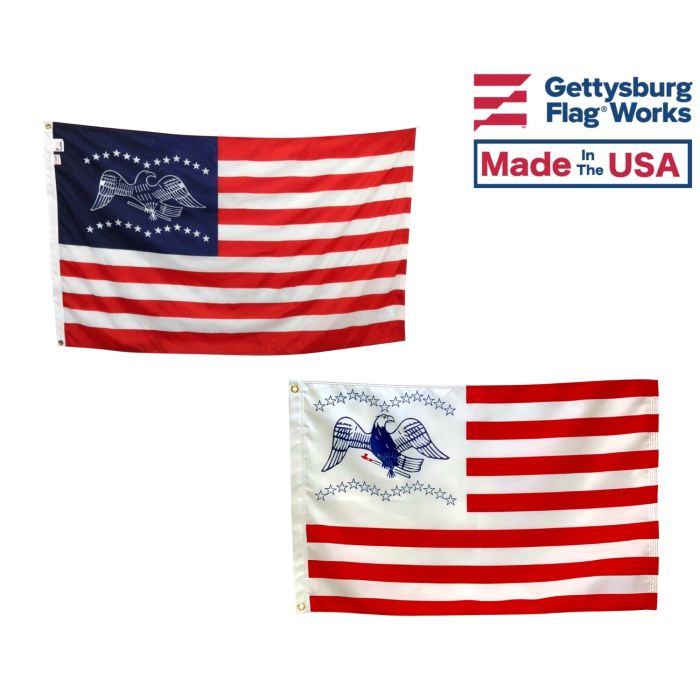
The historical flag of General Fremont was designed and made in 1841 by his wife Jessie Benton Fremont. It accompanied him on what would be the first of three expeditions to the west. Fremont knew his travels would take him beyond national boundaries so he couldn’t carry the Stars and Stripes. The flag was designed with elements of the U.S. flag specifically, the square canton with red and white stripes. The eagle motif in the canton is holding a peace pipe or “calumet” in its talon rather than the traditional olive branch. The imagery was intended as a message of peace to Native people.
The General Fremont flag with a blue canton is more commonly available today but the version with the white canton is more historically accurate.
The flag was first unfurled on August 15, 1842 upon the crest of the Rocky Mountains. Fremont wrote how we flew the flag at “Snow Peak” which is now known as Fremont Peak in present day Wyoming. He wrote how he unfurled his flag to “wave in the breeze where never a flag had waved before”. After returning from his expedition, his wife backed the flag with a piece of her lilac silk wedding dress and embroidered “Rocky Mountains, 1841” in gold. The flag is said to have been carried on his third expedition in 1845, which historians remark as a turning point in Carolina history. The original flag was then donated to the Southwest Museum in 1905 by Fremont’s daughter Elizabeth. The museum was then absorbed by the Autry Museum of the American West in Los Angeles, where the flag resides today.
Flag Size Recommendations
12x18” - Used on boats, wall decoration or on stick flags for celebrations
2x3’ - A smaller flag size usually used on large boats, RV’s or small flag poles
3x5’ - The most common flag size. Used on 6' house-mounted poles or in-ground poles up to 20' tall
4x6’ - Traditionally used on 25' tall in-ground flagpoles
5x8’ - Made for use on 30' tall in-ground flag poles
6x10’ - Made for use on 35' - 40' tall in-ground flagpoles
Header and Grommet style - This is the most popular way to attach a flag and is used on house mounted poles and in-ground flag poles. Generally made of brass and connected via snap clip or plastic grommet rings like our rotating spinning pole.
Need a bigger version of this flag? Contact us for assistance!
More About General Fremont
John C. Fremont was nicknamed “The Pathfinder” as a nod to his expeditions to the Far West during the 1840s. While his travels and contributions to the state of California was the source of his claim to fame, Fremont also had an interesting career in politics. Following his expeditions he and his wife settled in California where we acted as military governor in 1847 and briefly as a senator. His strong anti-slavery stance caught the attention of the newly formed Republican Party and Fremont was selected as their first presidential candidate in 1856. Campaigning against James Buchanan, Fremont’s slogan was “Free Soil, Free Men, and Fremont”. Despite losing the election, Fremont used the connections later on to become a major general for the Union Army in the Civil War.
In August of 1861, Fremont became frustrated with how the war was progressing and took matters into his own hands. He declared martial law in Missouri and announced the emancipation of all slaves in the state. Shortly after this, Fremont was relieved of his command and despite being given another command position in 1862, removed himself from the war efforts entirely. He went on to serve as the territorial governor of Arizona from 1878-1881 while his wife found success with her published writings.
Related Products & Accessories
Expanding your historical flag collection with other historical flags, and lapel pins has never been easier. Stocked and ready to go!
More Information
More Information
SKU
ConfigGeneralFremont
California Proposition 65
yes
California Proposition
CALIFORNIA PROPOSITION 65 WARNING
This product can expose you to chemicals which are known to the State of California to cause cancer,
birth defects or other reproductive harm.