
Dead Men Tell No Tales: The Stories of Pirates and their Flags
The age of pirates is a legendary piece of world history; inspiring movies, books and many Halloween costumes. Along with the theatrical persona and entertaining antics we associate with pirates today, many iterations of pirate flags have become a part of pop culture. But pirate flags aren’t just fun designs, they come ingrained in history and infamous pirate tales from before the United States was even born.
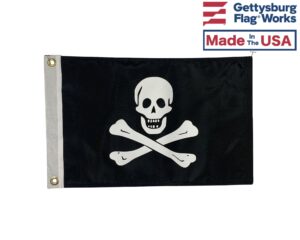
The first thing that pops into your mind when I say “pirate flags” is probably some iteration of a skull and crossbones on a black background. This design is the most popular and commercialized pirate flag and is actually called the Jolly Roger. The flag itself isn’t associated with any specific pirate and pirate flags were just as often red as they were black. The design of the skull and crossbones comes from old ship logs, where it was written to represent a death on board. There are two different theories as to where the name “Jolly Roger” came from. The first instance of the word appearing in print is from the 1724 book The General History of Pyrates, but it doesn’t quite dig into the actual origins. Some believe the name is derived from the French “joli rouge” which was their name for red pirate flags. The other theory is that “Roger” or “Old Roger” was a common nickname for the devil and the “Jolly” part is referencing the grinning skull on the flag.
Despite being the most recognizable pirate flag, it’s unclear if the Jolly Roger was ever actually flown on pirate ships. Most pirates chose to fly their own personal flag designs and often swapped around many different ones. Pirate ships were even known to fly false flags as a way to fool targeted ships and hoisted the pirate flags at the last second to frighten them into surrender.
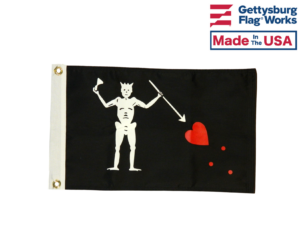
Arguably the most infamous pirate to ever live, Edward Teach or “Blackbeard”, turned two years of piracy into a lasting legend. Blackbeard is an iconic pirate for a reason. He cut a terrifying appearance with three pistols strapped across his chest and knives hanging from his clothes. In addition to the long black beard that gave him his name, he was known for putting braids and ribbons in it. He would even place lit fuses in his beard while attacking ships to scare them into surrendering. Blackbeard’s physical appearance combined with his flag was known to be a fierce image on the seas. The design features a horned skeleton, with an hourglass in one hand and a spear piercing a heart with the other. Aboard his flagship the Queen Anne’s Revenge, Blackbeard was a frightening presence during the golden age of piracy.
Blackbeard was killed in 1718 by the Royal Navy but not before receiving 20 cutlass wounds and five pistol shots. Once he was killed his severed head was hung from the bow of the ship while his body was thrown overboard. For years later his head was displayed on a stake in Chesapeake Bay. Legend has it his skull was later lined with silver and used as a drinking cup. In 1996 the wreck of the Queen Anne’s Revenge was found off the coast of North Carolina in the historic Beaufort Inlet. Thousands of artifacts have been recovered through the years and scientists continue to work on analyzing and uncovering their stories.
Bartholomew Roberts – Black Bart
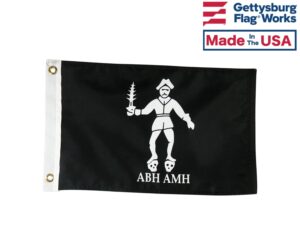
One of the more vicious pirates of the age, Bartholomew Roberts or “Black Bart”, captured hundreds of ships in just three years of piracy. His flag featured a man holding a flaming sword, standing on the slaughtered heads of his enemies. The skulls and below text represent a conquered Barbadian and Martiniquian head. Several of Black Bart’s flag designs have survived through history: another shows Black Bart and Death holding an hourglass. These designs were meant to strike fear into an enemy and announce his presence on the seas.
The death of Black Bart is marked as the beginning of the end of the golden age of piracy. In the moment he was killed, his crew quickly weighed his body down while still dressed in finery and threw him overboard. It was his long-held wish that any enemy would be denied from capturing him – even in death. To this day, the body of the pirate great was never found.
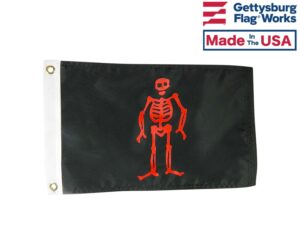
Edward Low is regarded as one of the most sadistic and cruelest of all pirate captains on the seven seas. He was notorious for evading capture by the authorities time and time again over the years. Low’s flag bears the image of a bloody skeleton on a black background, intended to instill terror in any who came across it. He got his start in piracy while working on a ship heading to the Bay of Honduras. The ship’s captain provoked Low, who subsequently led a mutiny and took control of the ship. Low and the remaining crew voted to turn to a life of piracy and declare “war against all the world”.
Rhode Island’s governor Samuel Cranston spearheaded a campaign to hunt Low down, and asked other colonial authorities to follow suit. What Cranston didn’t realize was that many stakeholders in the American colonies actually viewed the pirates in a positive light. Sure, pirates disrupted shipping but they also traded the goods they stole at far less than face value, causing local communities and smugglers to appreciate them. This positive attitude towards pirates was so widespread in Rhode Island that Bostonians came to call them “Rogue Island”.
The most detailed description of Low and his crew actually comes from Philip Ashton, a fisherman captain who was held hostage for nearly a year. Ashton’s writings detail Low’s adventures, his narrow escapes, and his plundering across the ocean. Low was last seen in the Bay of Honduras in 1726, when he escaped from the Royal Navy into the jungle where he was never seen again.
Thomas Tew – The Rhode Island Pirate
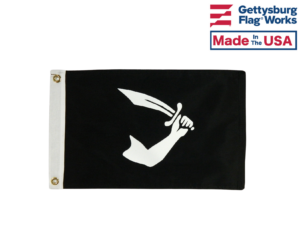
Known as “The Rhode Island Pirate”, Tomas Tew came from Newport, Rhode Island and became an infamous pirate upon the Red Sea. His flag design features a white arm holding a short scimitar on a black background. The theme was meant to represent his strength and fearsomeness as a pirate. It’s rumored that Tew was even close friends with the New York governor who assisted in approving his exploits. He led two major expeditions that managed to acquire more treasure than he could spend before his death. When it came time for the Newport Distilling Company to name their first product they chose to name it after the local legend: Thomas Tew Rum. Originating as a privateer, Tew would go on to become one of those iconic pirates whose name lives on in history.
Want more flags??
These are just a few of the pirate flags we carry here at Gettysburg Flag Works. Shop our entire collection of pirate flags to find the best one for you! Looking to deck out your boat? Check out all of our beautifully made boat flags. Can’t find a design you like? Design your own custom boat flag and we’ll bring your vision to life!
References: