
Troy Native, WWII Veteran’s Remains Come Home After 80 Years
More than eight decades after he was declared killed in action, Second Lieutenant Joseph “Roy” Burke of Troy has finally returned home. Once lost to the chaos of war and buried among the unknown, Burke will now be laid to rest with full military honors—his name, story, and sacrifice restored.
Early Life and Promise
Born in 1914, Burke grew up in Troy and graduated from Catholic Central High School in 1932. He went on to attend Siena College, where he was a member of its second graduating class in 1938.
Driven by a passion for aviation, Burke enrolled in the Civilian Pilot Training Program at Albany International Airport. There, he trained to fly the P-40 Warhawk, setting his course toward military service. In 1940, he enlisted in the United States Army Air Corps, just as global tensions escalated into World War II.
War and Captivity
Burke was stationed in the Philippines as a cadet pilot when Japanese forces launched their assault following the attack on Pearl Harbor on December 7, 1941. His squadron’s aircraft were destroyed in the initial strikes, leaving him grounded and reassigned to infantry duty.
He joined the defense of Corregidor, where American and Filipino forces made a final stand. On May 5, 1942, Burke and hundreds of others were captured as Japanese troops overran the island.
Over the next two years, he endured harsh conditions as a prisoner of war. In December 1944, he was forced
 aboard the Oryoku Maru, one of the notorious Japanese “hell ships”—unmarked vessels used to transport prisoners under brutal and overcrowded conditions. When Allied aircraft attacked the ship, unaware of the POWs onboard, Burke survived the sinking by swimming ashore.
His survival was short-lived. In January 1945, he was loaded onto another transport, the Enoura Maru. Days later, Allied airstrikes again struck the vessel. Burke and approximately 1,600 fellow prisoners perished.
Lost Among the Unknown
In 1946, recovery teams exhumed a mass grave containing hundreds of remains linked to the attack. Without the means to identify them, the dead were buried as Unknowns at the National Memorial Cemetery of the Pacific.
For decades, Burke’s fate remained uncertain. His name was listed among the missing, his story unfinished.
That changed generations later. Between 2022 and 2023, the Defense POW/MIA Accounting Agency disinterred
remains associated with the Enoura Maru. Through DNA analysis, dental records, and historical research, one set of remains was conclusively identified as those of Second Lieutenant Joseph “Roy” Burke.
A Hero Returns Home
On May 1, 2026, Burke’s remains arrived at Albany International Airport—the same place where he once learned to fly. Surrounded by family members and a full military honor guard, the long-missing airman was welcomed home.
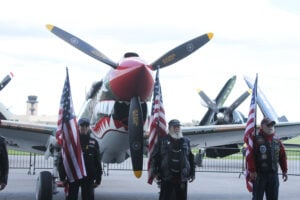
He will be laid to rest at the Gerald B. H. Solomon Saratoga National Cemetery following funeral services at Siena College on May 7.
For his family, the return brings both closure and pride. Reflecting on the moment, his nephew John Burke said,
“He’s been in mass graves and unmarked graves, and now he’s in a marked grave with honor.”
Restoring Names, Restoring Honor
Burke’s story is one of thousands still being uncovered. The United States remains one of the few nations committed to recovering and identifying its fallen service members, no matter how much time has passed. Through the ongoing work of the Defense POW/MIA Accounting Agency, families are given long-awaited answers—and soldiers like Roy Burke are finally brought home.
After more than 80 years, a young pilot from Troy is no longer missing. He is remembered, identified, and honored—exactly as he should have been all along.